
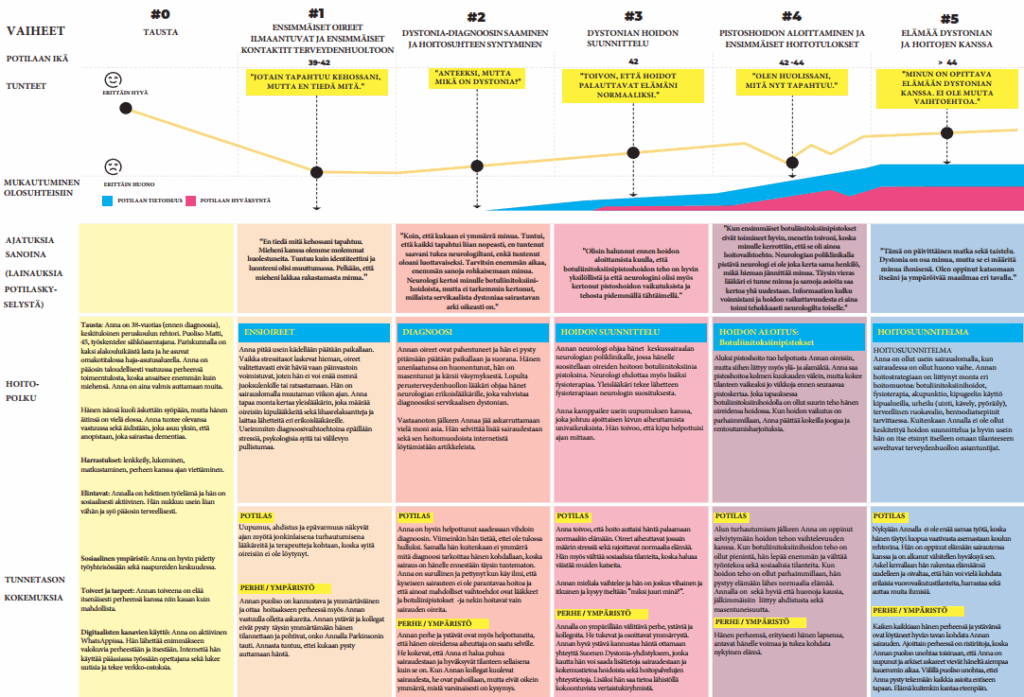
Potilaan asiakaspolut ovat infograafisia yleiskatsauksia, jotka havainnollistavat harvinaissairaiden potilaiden hoidontarpeita. Koska polut ovat potilaan näkökulmasta suunniteltuja, ne mahdollistavat lääkäreiltä paremman reagoinnin harvinaissairaiden potilaiden tarpeisiin.
Potilaan poluissa huomioidaan se, että potilaiden tarpeet voivat vaihdella sairauden eri vaiheissa – esim. alkuvaiheen oireet vs. hoito. Ne heijastavat myös potilaiden henkilökohtaisia kokemuksia, jotka voivat vaihdella henkilöstä, hoitoyksiköstä ja maasta riippuen.
ERN-RND katsoo potilaan polkujen olevan työkaluja, joilla potilaat ja lääkärit voivat yhdessä tunnistaa hoidon kehittämiskohteita ja mukauttaa hoitopolkuja vastaamaan paremmin näiden sairauksien kanssa elävien potilaiden tarpeita. Potilaan polut voidaankin nähdä ensimmäisenä askeleena kohti potilaiden järjestelmällistä osallistamista hoitopolkujen suunnitteluun.
Lisäksi potilaan polut ovat hyödyllinen työkalu niin potilaille, läheisille, yleislääkäreille kuin suurelle yleisöllekin, jotta he ymmärtäisivät paremmin harvinaista neurologista sairautta sairastavien potilaiden hoitotarpeita.
Voit ladata infograafin ja taulukon pdf-tiedostona klikkaamalla kuvia.
Löydät täältä servikaalista dystoniaa sairastavan potilaspolun esitteenä.
This work is generated within the European Reference Network for Rare Neurological Diseases—Project ID No 739510. The authors thank all the people living with CD who participated in the patient survey and in the expert-patient focus group. We also thank Dystonia Europe, AMADYS, Associazione per la Ricerca sulla Distonia A.R.D., and Action for Dystonia, Diagnosis, Education and Research [ADDER]) for their assistance in recruiting patients to the survey and participation in the expert-patient focus group. Medical writing support was provided by Anita Chadha-Patel, PhD, of ACP Clinical Communications Ltd (Hertfordshire, UK), which was funded by Ipsen (Paris, France) in accordance with Good Publication Practice guidelines.
Authors’ information
Monika Benson is executive director of Dystonia Europe. Monika has cervical dystonia and was a board member of the Swedish Dystonia Association for 10 years. Monika has been working as a coordinator of workshops, courses and lectures at a school in Lund, Sweden.
Alberto Albanese is Professor of Neurol- ogy and Head Neurologist at the at Humanitas Research Hospital, Rozzano, Milan. He has authored over 200 publications covering an ample spectrum of movement disorders, including dystonia, Parkinson disease, choreas and tics. He was a leading pioneer in the introduction of botulinum toxins in Italy and has pioneered the use of deep brain stimulation in movement disorders.
Kailash Bhatia is a professor of clinical neurology in the Sobell Department of Movement Neuroscience at the Institute of Neurology, UCL, Queen Square, London and an honorary consultant neurologist at the affiliated National Hospital for Neurology, Queen Square. He has published over 500 publica- tions in the field of movement disorders and is the current chairman of the Movement Disorders subcommittee of the European Neurological Society (ENS). His main research interest is in movement disorders, merging clinical, electrophysiological and genetic methods to study the pathophysiology of conditions like dystonia, tremor and parkinsonism.
Pascale Cavillon is Global Patient Centricity Director for Ipsen where she oversees patient support pro- grams designed to help patients with chronic disease requiring chronic and or complex medication therapy living with their disease and improve patient outcomes. Lorraine Cuffe is Medical Director for Ipsen.
Kathrin König is Sen- ior Project Manager for PARTNERSEITZ, a patient experience research company specializing in the development of patient journey maps.
Carola Reinhard is a research manager at the Institute of Medical Genetics and Applied Genomics at the University Hospital Tübingen. She is project manager of the European Reference Network for Rare Diseases (ERN-RND).
Holm Graessner is managing director of the Centre for Rare Diseases Tübingen, Germany. He is Coordinator of the ERN-RND.
We thank Jukka Sillanpää for the translation of the patient journey to Finnish. He has had cervical dystonia for more than 10 years and received BTX-treatment every three months. He has been president in the Finnish Dystonia Association for six years.