
Programme Purpose
The ERN-RND postgraduate curriculum equips medical doctors with advanced competencies in rare neurological diseases (RND). The programme supports trainees in recognising RND, identifying individuals and families at risk, establishing clinical diagnoses, selecting and interpreting genetic and other diagnostic tests, and managing care and treatment across multiple care settings.
The curriculum prepares trainees to care for patients and families in line with current and evolving scientific knowledge, including molecular and cellular disease mechanisms, diagnosis, treatment, communication and counselling.
Patient-care activities are translated into domains, competencies, learning objectives and entrustable professional activities (EPAs), which form the basis of each module.
The eLearning path of the Postgraduate Curriculum is hosted on:
Modul-based Training
ERN-RND offers modules corresponding to the six disease groups covered by the network. We are starting now with Ataxia and HSPs, the other disease groups will follow soon. Apply now.


The five Learning Domains
General/Theory
Diagnostics/
Neurogenetics
Specific Disease Management Aspects
Treatment/
Therapy
Communicating with and Counselling Patients
European Certificate
The curriculum is designed to support assessment towards the European Certificate in Rare Neurological Diseases (ECRND), which is intended as a knowledge-based assessment tool for RND competency training in Europe.
Successful completion requires knowledge-based assessment of the online learning path, an accepted logbook/portfolio for the expert-centre stay and a final oral exit examination.

Description of the modules
Each module combines flexible online learning with applied clinical training at an RND expertise centre.
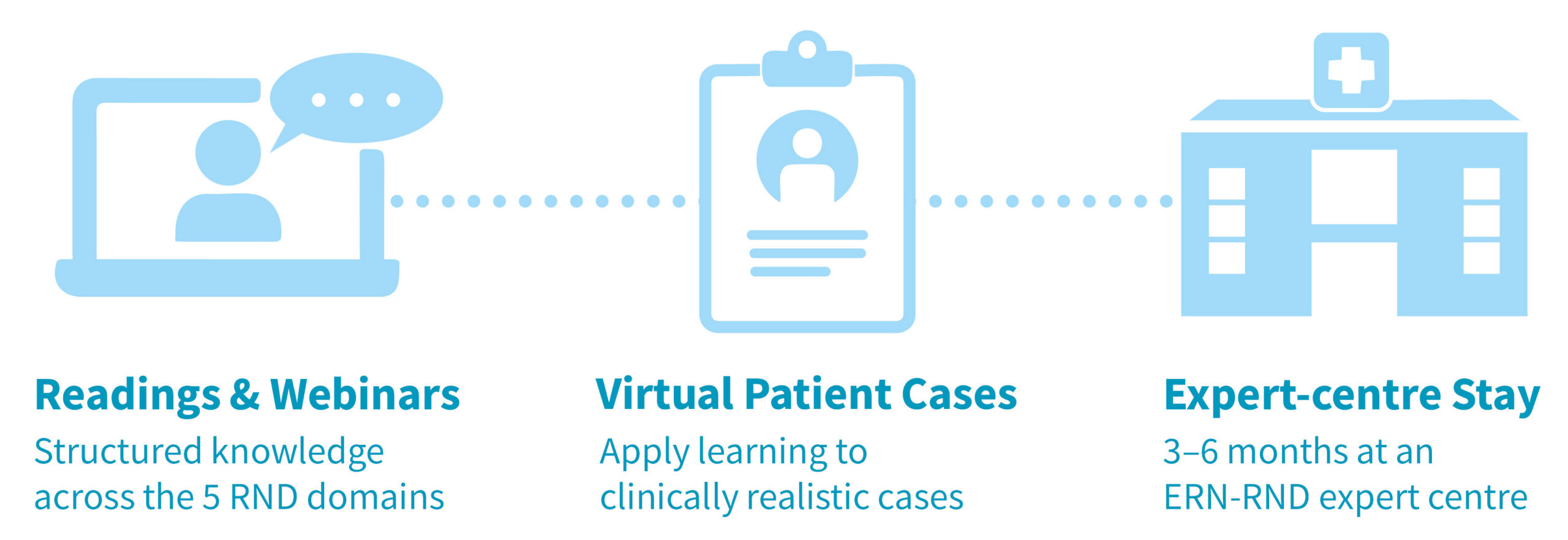
The online learning path includes an introduction, recommended readings, educational webinar recordings and virtual patient cases in e-learning format. Webinars are mapped to the five learning domains and to the competencies and learning objectives of the respective disease group.
After completing the online learning path and the required knowledge tests, trainees undertake a 3-6 month stay at an ERN-RND member centre. We are working on a framework to allow stays at other European nationally recognised expertise centres for the respective disease group in the near future as well.
During the stay, trainees consolidate knowledge, apply it in clinical practice and document training activities in a competence-based logbook.
The module concludes with an oral exit examination.
Timeline
- Online learning path, including readings: to be completed within 18 months of enrolment.
- Expert-centre stay: 3-6 months, to be completed within further 18 months.
- Maximum duration per module: 3 years.
Eligibility
The curriculum is open to medical doctors who have completed their general professional training and are either:
- enrolled in an accredited training programme to become a recognised specialist in Neurology, Child Neurology or an RND-related specialty such as Medical Genetics; or
- already board-certified in one of these specialties.
Applicants should be able to participate in English-language training and assessment; C1-level English is recommended for the examination.
Applicants are asked to provide a motivation statement.
Applicants should identify a supervisor.
Expert-centre Stay Requirement

The expert-centre stay may take place in an ERN-RND member centre or the trainee’s own home institution if it has the required expertise and is approved for this purpose. We are working on a framework to allow stays at other European nationally recognised expertise centres for the relevant disease group in the near future as well.
Training centres must provide adequate infrastructure, sufficient patient volume and case mix, experienced teaching staff and access to multidisciplinary care. The stay should expose trainees to a broad range of clinical experience, including diagnosis, management, follow-up and care coordination.
Training is led by a responsible RND specialist who mentors the trainee, supervises competence development and ensures that training activities are documented and reviewed.
The mentor should meet ERN-RND criteria for the respective disease group, like for example at least 100 patients visited, treated or followed per year and at least 20 new patients per year.
Logbook Requirement
Each trainee keeps a logbook/portfoilio documenting completion of webinars and educational cases, clinical exposure and progression towards the required competencies and EPAs.
The logbook should include:
- training activities and dates, including webinars and educational cases
- certificate after completing the online learning path, issued by the EAN in cooperation with ERN-RND
- competence-based records of diagnosis and care-management activities, including care across multiple settings and transition from paediatric to adult services where relevant
- counselling of patients and families about genetic causation
- counselling about psychological, social and lifestyle issues
- publications and research/clinical presentations, where applicable.
At least 20 RND cases should be documented for EPA reporting. The logbook must be reviewed regularly and signed by the trainee and the designated ERN-RND clinical expert

Examination Rules
Successful completion of the programme requires:
- completion of the online learning path
- knowledge tests for the five domains, with at least 80% correct answers
- an accepted logbook/portfolio following the expert-centre stay
- a final oral exit examination based on the module domains and learning objectives
The oral exit examination is conducted by the responsible senior expert together with two additional ERN-RND experts, who provide an overall judgement on the trainee’s competence and fitness to practise independently in RND.
